Monday, January 2, 2012
New Year, New Gear
Friday, August 26, 2011
Upstaged
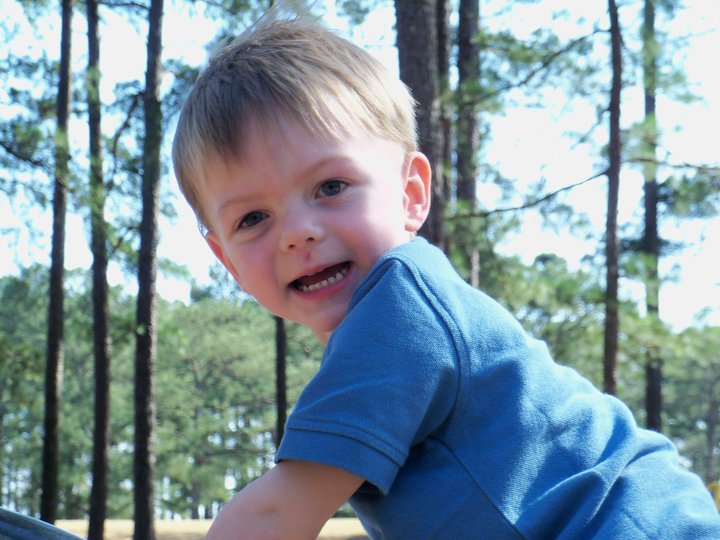
My four-year-old grandson, Drew, is a fine boy. He’s just past that stage where he’s figured out how smart he is and how dumb his parents are. (Grandparents, of course, know this stage reemerges multiple times in a child’s development . . . or else it just continues in one long, uninterrupted stretch from age three until he has children of his own.)
Anyway, a couple of months ago, Drew began telling his mother she was wrong about everything. His mother, my first-born, wisely and patiently endured and ignored him until it became clear that his contradictions weren’t going away without her help. So she very firmly told him to be quiet. Which Drew did. For a few seconds.
And then he had an idea. He said he wanted to sing a song about a train. Not wishing to be unreasonable, Mom agreed. Then Drew began to sing his train song. It went, more or less, like this:
“You think you know, but you don’t!”
Drew's mom has also just passed through a stage, one that began at bewildered and, in a flash of insight at Mach 1, wound up at shrewd.
Stifling a laugh, she sent him to his room.
Sunday, July 17, 2011
No Contest! Creation Wins!
A Review of
It Couldn’t Just Happen, by Lawrence O. Richards
(Tommy Nelson: A Division of Thomas Nelson Publishers, Nashville, 2011)
In some ways this book is excellent: it is brimming with fantastic facts, gorgeous photography, and sound argumentation against the Theory of Evolution. It is organized and argued clearly so that the advanced ten-year-old or the average teenager would have little difficulty following or understanding. From Part One, which deals with the origins of the universe and Earth as the “Odd Planet,” right through Part Four, which deals with the special creation and status of human beings, the author weaves the Biblical view like a brilliant, red thread. Part Five, The Book That Didn’t Just Happen, deals with the historicity and believability of the Bible and Christian faith. More on that in a moment.
Young Christians and their parents will find affirmation and ammunition aplenty in this book. For instance, in Chapter 11, “The Wonders of Design,” the author points out that no one who examined a modern car would argue that the car had not been designed, that it had “just happened.” Not a chance that the air conditioning, radio, the Global Positioning System had come about by accident. All of its integrated features reveal a carefully planned design and suggest one or more designers. And a car is nowhere near as complicated or integrated as plant and animal life on Earth, let alone the vast, interrelated systems that operate all over the globe and throughout the cosmos.
Another example is the argument from the Second Law of Thermodynamics, which states that any physical system left to itself will decay. Yet (and especially if, as Evolutionists claim, the earth is millions of years old) the earth’s systems, such as the processes in the oceans and the atmosphere, aren’t decaying. On the contrary, says Dr. Richards, they constantly readjust themselves; they reorganize. Evolution can't explain that.
Even though I myself am a believing, professing Christian, I could have done with less of what you might call Biblical polemics, inserted and repeated in every chapter and every major division. Children and teens are smart enough to know when they are being “sold.” They want to discover things, to think things through for themselves, and this book doesn’t allow for much of that.
It Couldn't Just Happen has some faults, most of them minor—like far too many exclamation points!—and I have disagreements with Dr. Richards’s theology in places (recognizing that he has theological credentials and I don’t), but all in all, this book is a wonderful addition to the Christian soldier’s arsenal.
Disclosure of Material Connection: I received this book free from the publisher through the BookSneeze®.com
Monday, June 20, 2011
Long Delayed BookSneeze Review
A Review of
Winston Churchill by John Perry
(Thomas Nelson: Nashville, TN, 2010)
This biography is an introduction to the life of Winston Churchill, painting it in broad, but not deep, strokes. The book takes us from Churchill’s sad childhood to the apex of his career as England’s Prime Minister during World War II and to his decline and death decades later. It also treats of lesser known episodes when Churchill served as foreign war correspondent in Cuba, India, and the Sudan.
Since the book is part of the “Christian Encounters” series, the author seems to have set out to find Christian influences in Churchill’s life. Finding a dearth of these and little evidence that his subject seriously believed or practiced Christianity, he is forced to conclude that Churchill’s Christian influences were mainly passive and “cultural,” part of the fabric of life in the times in which he lived. I find this the major flaw of the book.
What puzzles, even after reading this biography, is how the mostly neglected child of wealthy, leisured aristocrats became an oratorical genius and the political mouthpiece of England. It is difficult not to believe, as he did, that it was his destiny.
Disclosure of Material Connection: I received this book free from the publisher through the BookSneeze®.com <http://BookSneeze®.com> book review bloggers program. I was not required to write a positive review. The opinions I have expressed are my own. I am disclosing this in accordance with the Federal Trade Commission’s 16 CFR, Part 255 <http://www.access.gpo.gov/nara/cfr/waisidx_03/16cfr255_03.html> : “Guides Concerning the Use of Endorsements and Testimonials in Advertising.”
Friday, December 31, 2010
364 Days Around the Sun . . .
Thursday, December 30, 2010
Small Wonder
We planted a row of heirloom English peas right after Thanksgiving, at the end of November, as Rodger the expert had directed. About ten days later, the peas sprouted, barely cracking the cold ground.
In mid-December it turned bitter cold: 11 degrees when I woke up one morning. The peas lay under a blanket of snow from late Christmas Eve, through Christmas Day, and the day after that.
A segment of our row of English peas today:
Like Little Children
Among them was a little boy about four years old we'd never seen before. His name was Gregory, but his speech was clumsy and Dad and I thought he said "Wagby." So Wagby he became. He was inquisitive. To any explanation Dad gave, he always had another question. It was: "WHY?"
"Mr. D., WHY did you light this fire?"
"To burn the leaves."
"WHY?"
"Because I didn't want them on the grass."
"WHY?"
"Well, because the yard looks neater without leaves everywhere."
"WHY?" . . .
And eventually the only answer Dad or anyone could give little Wagby was a frustrated BECAUSE!
I think of Wagby whenever I read Christ's words, "like little children." And I identify. I'm by no means a little child, but my middle-aged world is still so full of "WHY?"s.
WHY does an optical image go through a pinhole inverted?
Because light travels in a straight line.
But WHY?
Because it does. Just because.
There's so much room for wonder. So many questions. All of which science proposes to answer, and all which leave one remaining question:
WHY?
Thursday, May 20, 2010
Chemistry & Physics
But he was so popular and my class so large that I never did make it up to the front of the auditorium after class to have a friendly chat with him about isomers of hydrocarbons before a long line of others with similar intentions had formed. I gave up trying about mid-semester.
But a story he told has stayed with me. Before he became a professor, he was a chemist in research and development for some large corporation. He concocted a product he thought would be a major breakthrough because it totally eliminated household dust.
It had only one problem, he said.
He took the cigar out of his mouth, and with his signature smirk and his eyes dancing over the auditorium, he said, "It was radioactive." Then he clamped his jaw back down over the cigar.
Bet you didn't know there was a physics lesson in chemistry. It's this: for every action to solve a problem, there is an equal and opposite reaction creating a problem that is twice as difficult to solve as the original.
You would think the U.S. government would have caught on to this one by now and left well enough alone!
Saturday, May 1, 2010
"He discovereth deep things out of darkness." Job 12
Saturday, April 24, 2010
Already Her Own Girl
"April is the cruellest month, breeding...
Tuesday, April 13, 2010
The Flavor of Hope
Two years ago in our somewhat barren back yard, we planted a slip of a peach tree. When it budded the very next day, we took that as a favorable omen. Sure enough, this March it bloomed glorious pink and set its first fruit--funny, pea-sized fuzzballs!
I grew up in the Black Belt, not far from Chilton County, the peach capitol of Alabama. The peach orchards there perch atop the last gasp of the Appalachian Plateau, a thin spur, cloud high, on a whisper breeze that overlooks the stifling plain of my childhood.
Eating peaches was like eating sweet April sunshine. The only thing I liked better in July was a rope swing over a creek.
Wednesday, April 7, 2010
How Do You Like Your Hard Drive?
I'm accepting the loss without howling and throwing things. So far, anyway.
Plus, I happen to like this blank-slate feeling. I'll just make a new and better start.
But here's some friendly advice: if a blank slate won't do for you, go ahead and back up your hard drive. Like...right now!
Friday, April 2, 2010
A Little Child Shall Lead Them

From his car seat, my grandson sees me and yells, “Hi, Mimi!”
He's a month shy of three years old. When he was born--slightly early, slightly underweight--I was there with his mother and dad. Now he's big for his age. Big feet, big understanding, big heart. He hides the eggs in the back yard. Then he insists on finding them too. We indulge him and help him remember where he put the last two.
Later, as his mother and granddad talk, I stoop and whisper, “Will you give me a hug?” He backs up to me. I'd be satisfied with this, but then he changes his mind, turns around and wraps me up in a serious embrace. I nuzzle him and kiss his neck, his cheek, before he pulls away. And again he changes his mind and comes back, puckered, to kiss me on the lips.
I drown in gratitude for his innocent affection. Unexpected. Undeserved. A foretaste of the love divine.
Sunday, March 28, 2010
Driving to My Country Church on Palm Sunday
Spring prompts lists as I drive:
swaths of forsythia
wind in the greening willow
of quince, of tulip tree,
of creekwater the color neither of stone nor sky.
of matter:
the pith of peach
the stark of forests dark
without the dogwood tree
the daffodils broken riotous free from
a dooryard—the farmwife long dead
the farmhouse fallen away—
to bloom on the hillside
in the shape of a cross.
begging:
to be rewritten
with verbs, drama, kindred
to be shredded, cast as confetti
to the funnel cloud
In lists, I limp
after the image of my Creator,
now and ever, the best that I can do.
The thunder subsides,
and I pass through a shower
of petals.
Saturday, March 27, 2010
Spring Sunset
Thursday, February 25, 2010
Friday, January 15, 2010
Update
Sunday, January 10, 2010
Goals for 2010
Yes, I'd like to be published before 2010 ends, and yes, I'd love for people to pay me for books and stories. But even more than that, I'd like to enjoy every step of the way on the path to publication--in 2010 or 2012, or some other year before I die. I want the gratification that comes from hard work done well. I want to be a happy writer even as I dare to fail badly.
Because learning to write well takes time, the writer who postpones happiness until that time sets herself up for a miserable life. I made that mistake when I was younger, thinking I'd be happy once I'd landed a certain job, or made enough money, or did something-or-other-always-out-in-the-future. That's a sure-fire recipe for misery, if not for failure and misery.
My motto, then, for 2010 is "Despite..." I pledge to enjoy learning how to write, despite circumstances that might arise. That way, I can judge myself a success whether I sell my work or not.
Thursday, December 24, 2009
THE Story
Remember always the story of all stories about the King of all kings. Praise Him!
Monday, December 14, 2009
The Blind Side and Fiction
The movie begins with a janitor trying to convince the athletic coach at a private, Christian school to enroll the janitor's son and, most important to the story, the son's friend, at the all-white school. Once the movie is underway, we never see the janitor or his son again.
In fiction, this would never work, and no fiction writer worth his ink would dream of doing it. One of the first rules of good fiction is that everything in the opening scene is of prime importance. Not just the characters, but the seemingly insignificant details as well. They need to have a bearing on the rest of the story. They need to subtly foreshadow coming events, so that the reader (or viewer) at some point recalls the beginning and says to himself, "Aha!"
You've probably read the writer's advice (I don't remember who wrote it) that if the opening scene of your whodunnit shows a shotgun over the mantel, you mislead your reader if your murderer uses a lead pipe instead.
If The Blind Side were fictional, the author would not have begun the story the way this one begins. Or, alternatively, he would have found a way to weave those introductory characters into the action of the story and wrapped the ending back to the beginning.
I'm not criticizing the movie, of course. (I loved it. Sandra Bullock is wonderful!) And I haven't read the book. I'm merely pointing out what anyone would notice if, like me, they're trying to write fiction.
Saturday, December 5, 2009
Praise & Thanksgiving
Now, you may be asking yourself why I've entitled this post "Praise & Thanksgiving" after hearing about Steve. But here are a couple of reasons:
1) Steve and his family have submitted themselves to the hand of God. They live each day in praise and thanksgiving that He alone controls their destiny. They are comforted knowing that the universe does not run around like a crazy-clock to no purpose.
As in-control as they (and we) would like to be, they (and we) just aren't. Nor do we have what it takes to run even the tiniest corner of the universe, much less a destiny that, God be praised, is interwoven with the destiny of so many others.
2) Which leads me to the second reason for praise and thanksgiving: our inter-connectedness. My middle daughter has a friend whose mother was just days ago diagnosed with brain cancer. I e-mailed them the information on the clinic that Steve attended. Six weeks ago I would not have had that information. I have no idea what this woman ultimately will do to deal with her cancer, but knowing that I, a total stranger, may have figured into her decision is pretty awe-inspiring--and humbling.
In my experience, times of trial are always filled with great blessings, to which our proper response is always praise and thanksgiving.
The would-be writer should pay attention to the wealth of lessons here. The best fiction must always mirror the purposive, interwoven, nature of the universe and of each life within it. The quickest way to get a reader to lay down your story is to write a plot with random, unrelated action that leads nowhere.
Likewise, the best protagonists display the same traits through trial that Steve and his family display. No reader will stand for a protagonist who whines about his troubles--unless he gets what's coming to him, learns his lesson, and changes his ways.
Which leads me to endings. Fiction is most loved, most cried over, most uplifting, most moving, if it mirrors life itself. Life-death is bitter-sweet.
If you can write like that, you've got yourself a bestseller.
Friday, November 6, 2009
Yeah, well . . .
Yeah, well . . . I didn't go fishing. And I wrote a grand total of 382 words, not counting this post.
What I did was, I went to NaNoWriMo and started an account.
NaNoWriMo. You know.
National Novel Writing Month. Like November, dude!
You join and you try to write a novel of 50,000 words in a month. I can't do math but I know that's a lot of words every day. Even more if you don't begin on the 1st of November.
And I didn't join until the 6th, so I'm already a word or two behind. But hey, I'll consider myself a success if I write 15,000 words in November! Or even 7,500. I think my borderline is somewhere around 5,000 though. If I can't do 5,000, I give myself a D minus.
The whole point is to write a bunch of crap really fast. Now that I can do!
No, seriously. The point is to write really fast so you don't have time to edit, procrastinate, overthink, or otherwise obsess so much that your brain freezes up and your plot won't move. Sound familiar?
If so, do yourself a favor and check it out. Here's the link again. NaNoWriMo.
Thursday, November 5, 2009
A Time to Cast Away Stones
I'm at the end of something, but I haven't figured out where or how to begin again.
Years ago, when my husband was frantically working toward his doctorate, he said there was a point at which it became counterproductive to pursue work that he had no taste for. Better to go fishing! Why wrestle with a task that, at a better time and in the right frame of mind, you might accomplish with ease?
But sometimes I don't take my own advice. This is the third time I have worked on a blog post. The first two I deleted because I just couldn't say anything meaningful. So I'm going fishing!
I'm as confident that my reservoir will fill again as I am that winter will follow fall. And when it does, my pen will be in my hand.
Wednesday, October 28, 2009
Autumn Pause
Like the seasons, my writing life is somewhat cyclical. I have these great bursts of creative summer energy in which I get a lot accomplished easily. Then I have these pauses, like autumn, where I have to pull back and ponder things before I can write easily again.
People come along and challenge me about things I thought I knew, make me shed my dried-up leaves. Sometimes life just gets too fast and frantic, or I just move too old and slow, to keep up. Sometimes all of these happen at once.
Anyway, when I do get going again, I expect my writing to be better than it was before I got sidetracked.
Friday, October 16, 2009
When to Quit
I thought about this today because I looked at a picture on the wall. It is something my father gave to me before he died. It's a matted and framed photograph of Paul "Bear" Bryant in a crimson jacket and tie, with a quote from the Birmingham Post Herald of December 15, 1982:
"There comes a time when you need to hang it up, and that time has come for me as head football coach at the University of Alabama."
Well, hey. If Bear Bryant had to hang it up, surely there would be no shame in me doing the same, would there? And so I quit the most lucrative job I could ever have hoped to land. For my children. For my husband. For my sanity. I went from having plenty of money and no time to having plenty of time but no money.
And I can testify that time is NOT money. Benjamin Franklin was mistaken. Anyone who tries to tell you it is, is either a knave or a fool. Time is worth infinitely more than money! In today's economy, it's about the only thing besides love itself that is truly priceless.
Saturday, October 10, 2009
As Old as Methusaleh, As Wise as Solomon
Similes and metaphors are vital to humans. We understand a new thing only by comparing or contrasting it to some already known thing. Yet we come into the world from darkness, with vague sensations of a world wider than the womb. That there is light must be the original knowledge. Even this, we could not grasp unless we had known the gestational darkness.
Before creating the sun in Genesis 1, God spoke light into existence. It is the light of wisdom by which we see everything else.
Be sure the similes and metaphors in your writing are as crisp as an October morning. Give your reader just enough sun in the beginning to keep him reading even after the sun sets.
Wednesday, October 7, 2009
Love at First Sight
My middle daughter’s ultrasound and the first images of my new granddaughter brought me to my knees and tears to my eyes. How remarkable, marvelous, miraculous it is--to go from loving the idea of a child forming in the womb to true and actual love for this baby girl whose features aren’t fully formed and who doesn’t yet have a name.
It truly was love at first sight; now I know what that means.
For you created my inmost being;
you knit me together in my mother's womb.
I praise you because I am fearfully and wonderfully made;
your works are wonderful, I know that full well.
My frame was not hidden from you
when I was made in the secret place.
When I was woven together in the depths of the earth,
your eyes saw my unformed body.
All the days ordained for me
were written in your book
before one of them came to be.
Saturday, October 3, 2009
One on Voice Mail & One on Hold
Now that he's broken the ice, he calls me a lot. Before he hangs up he says, "I love you, Mimi. Bye-bye."
Having children in your life--your own, your friend's, or your grandchildren--is a big plus in many ways. If you intend to write fiction and/or nonfiction for children, they can help you create believable characters or inform you as to what subjects interest children of a certain age. Some published authors say that you can get by on your own childhood memories, but I'm not so sure.
Btw, my middle daughter finds out in three days whether she's having a girl or a boy!
Blog Hijacked By Alien Clone?
Friday, October 2, 2009
Lost & Searching
It's that tug of longing after the rain, and the inhalation of tall trees. They draw you into the secret recesses of childhood, the shadows of hedges, the mazes between the negative spaces of things. They call to you as they did in childhood: "Look here, in the shadow realm, because the things you seek aren't out in the clear light."
Immersed in childhood's idyllic light-womb, we all are lost. We wait for the change to come, anxious for things to change--as if all change is progress and nothing present, no present reality, has any value whatsoever. Precisely because the present reality is so good, so comfortable, so unchangeable, it gives rise to that future-longing.
The light is so bright we long for the relief of shadow, of relaxed dimness, and a motion toward sleep.
We lose ourselves eating. Eat rather to stay alive. Eat consciously. Use writing as your spice. Use adjectives as condiment, specific verbs as sauce. Slim down on your diet. Eat voraciously in your writing life.
Walk heady into the horizon, as if you weren't lost. The "eureka" moment is illusive because momentary. The search is the thing. Paradoxically, in searching you are found, located as surely as if tracked by GPS. The plumb line of heaven drops when men stop seeking staircases to God and learn about the divine that inheres in what fascinates them.
The fountain recirculates, the artesian well brings back to the surface the hidden secrets of the deep. The standing rain carries our prayers with it, seeping slowly into the water table, mingling in the moist eye of God. He weeps for our frailties, our blindness, and sends a spring up through the parched ground. The mountain receives the blessing coming up from below and coming down from above. Men, therefore, climb and don't know why.
They think they have met God on the mountain as Moses did. They are most gravely lost, even as God leads them gently, like lambs, down the rocky path to pasture.
He can be known, but in this life, He has so many impostors.
Monday, September 28, 2009
Shadow Feet
I want to walk, maybe even run, to meet the future, not let it sneak up on me like a dogging shadow.
And this is the attitude I take toward writing. I could go about my routine, have snatches of ideas that never make it to the page, and merely wish to be a writer. I've tried that.
Or I can sit down--every single day, or as close to every day as possible--and write. No matter what. Since I can't stay conscious of time passing, I must discipline my passage through it. Of course, there aren't any guarantees that I'll ever publish a word. But the journey counts for something. Maybe everything.
Writing every day is like putting your real foot down on that shadow foot. It's not always glamorous. But when your writing is good, it's like running to meet a future that's running to meet you.
Friday, September 25, 2009
Art & Life?
Amazing, how life and art intersect, right? Or how "coupon-ing" and writing do. A coupon taught me how to spell "Reddi-wip," which I misspelled "Redi-Whip" in a previous post, Blue Jello & Redi-Whip.
Important Note: The product itself says "Reddi wip, without the hyphen, but the website says www.reddi-wip.com, with the hyphen. Who knew?
The Truth About Nonfiction
My next writing assignment is to write a nonfiction article for children. This one can require research, but doesn't necessarily. For instance, it can be a how-to article on a subject I already know something about. How to make a sailboat cake, for instance, from two round layers. I did this for my daughter's baby shower, and I still have the pattern I drew for it. (My daughter kept the little baby doll that lay on the deck.) But I probably won't write that article because I have something more fun in mind that will require a little research.
The next several assignments are for nonfiction. I look forward to them because I know there's a lot to learn about the resources available to writers. And I'm told that, even in better economic times than these, it's much easier to sell nonfiction than fiction. And that's the truth.
Saturday, September 19, 2009
Potters and Clay
For those of you struggling, as I am, to deal with the huge and numerous demands a story makes on you, this exercise should teach you lots. Not merely that focusing on sensory detail will create a proto-plot, but also that paper-doll characters come to life in the midst of realistic detail. That's just short of miraculous!
In my completed assignment, six characters walk on the beach, including a child as the point-of-view character, her father, stepmother, and three siblings. None are named or physically described, and the only dialogue is a brother yelling, "Sand crab!"
Nevertheless, the people in this vignette seem real by virtue of being plunked down in a real, sensory setting, where the moonlight scribbles its reflection over the water, sparks fly off a cigarette, and the smells of burnt paper and menthol are in the wind.
Your nouns must be specific and carefully chosen, and your verbs active and specific. (Example: not the general noun, "road," but the specific, "Alabama highway 159;" not the general verb, "walked," but the specific, "slogged.") If you get the nouns and verbs right, you won't need many adjectives and adverbs. That is, you won't go "over the top."
I'm really amazed: (1) that anyone (even I) who can conjure up the sensory details of a remembered scene can actually create and evoke an alternate universe by making specific, black marks on a white page; (2) that anyone who can read (that is, decode the specific, black marks on a white page) can enter that reality; and (3) what remarkable creatures we are--"clay that can throw its own pots!"
Monday, September 14, 2009
Story Time Picture Books
I recently solicited picture book recommendations from professional writers and illustrators in Alabama, Mississippi, and Georgia--either their own work or their favorites, which sometimes happen to coincide. :-) Thanks to all of the members of the Society of Children's Book Writers and Illustrators (SCBWI), Southern Breeze Region, who responded. I haven't made a decision about what to read yet, but the list, below and in no particular order, is well worth keeping. It should be a great study resource for the pre-published writer (yours truly) as well as for moms with preschoolers.
And by the way, you can find ALL of these books on Amazon.
- All of the Dr. Seuss books
- Brown Bear, Brown Bear, What Do You See? by Bill Martin, Jr. & Eric Carle
- What Makes You Giggle? by P. J. Shaw and Tom Brannon
- Abby Cadabby's Rhyme Time by P. J. Shaw and Tom Leigh
- Spooky Sleepout! by Eric Suben, P. J. Shaw, and Joe Ewers
- Look Both Ways: A Cautionary Tale by Diane Z. Shore, Jessica Alexander, and Teri Weidner
- Bark, George by Jules Feiffer (2 votes)
- The Wide Mouth Frog by Keith Faulkner and Jonathan Lambert
- If You’re Happy and You Know It by Jan Ormerod and Lindsey Gardiner
- Almost all books by Eric Carle
- Leonardo the Terrible Monster by Mo Willems
- Don’t Let the Pigeon Drive the Bus by Mo Willems
- Little Penguin’s Tale by Audrey Wood
- The Napping House by Audrey Wood and Don Wood
- Shaping Up the Year, Tracey M. Cox and Samantha Bell
- If You Give (a Moose, a Mouse).... series, by Laura Joffe Numeroffand Felicia Bond
- If You Give a Mouse A Cookie by Laura Joffe Numeroff and Felicia Bond<
- The Three Pigs by David Wiesner
- A Light in the Attic by Shel Silverstein
- Agatha's Feather Bed by Carmen Agra Deedyand Laura L. Seeley
- A Fly Went By by Mike McClintock
- Traction Man Meets Turbo Dog by Mini Grey
- The Stray Dog by Marc Simont
- The Snowy Day by Ezra Jack Keats
- Click, Clack, Moo: Cows That Type by Doreen Cronin (2 votes)
- Olivia by Ian Falconer
- The Very Hungry Caterpillar by Eric Carle
- Alexander and the Terrible, Horrible, Very Bad, No Good Day by Judith Viorst and Ray Cruz
- Trosclair & the Alligator by Peter Huggins and Lindsey Gardiner
Sunday, September 13, 2009
It Impends
An impending event, despite possible danger, always seems weirdly romantic somehow. Like a tornado headed in your direction, it has a push/pull effect. Curiosity makes you want to sneak a look at the twisted thing, but another part of you just wants to dive for cover.
"Depend" is much less interesting, its derivation coming from a word meaning to "hang from." Pendants depend from chandeliers. That could be a big deal, depending upon whether or not you are standing beneath one when a tornado impends.
Wednesday, September 9, 2009
Writing Music
Saturday, September 5, 2009
Blue Jello and Redi-Whip
The leader of my new writer's group handed me a book by Julia Cameron, The Vein of Gold: A Journey to Your Creative Heart. This is not a book for everyone; in fact, all of it is probably not for any one. It's less like a how-to book and more like a cafeteria: take what you like and pass the rest on by. Two topics that I grabbed eagerly for, the way my children used to grab for the blue Jello and Redi-Whip, were walking and morning writing.
I've been a fan of walking since childhood. I've also always been a morning person. When I've had my choice, I've written in the morning. All the same, I never would have thought to put these two things together, and in this order: walking in the morning, and then writing--until I read a section of The Vein of Gold. The book doesn't actually say to put them together. This is my discovery and, I think, an improvement on the book.
After you walk or run for 20 minutes, you trigger the release of endorphins, the proverbial "runner's high" that happens to walkers too. You can actually feel it when it happens: a funny sensation at the base of your skull, behind your ears. Walk as long after this as you like, but then go home, get out your pen, and write away. I think you'll be amazed. Sometimes writing in the morning can be like skimming scum off a pond, but this should feel more like riding a jet-ski or diving for pearls in the deep. Try it.
Courage
There was a time in my life when I wouldn't have had the courage to even show up, much less read my work aloud to total strangers. "Courage?" you say. "Why, that's as easy as falling off a log." Yeah, I know.
It is . . . now.
Thursday, September 3, 2009
Schizo on My Shoulder
I've had a hard time convincing myself that free-writing isn't just a waste of time, a selfish indulgence, or worse.
Lately, however, I've noticed my free-writes have become less like "stream-of-consciousness" tomfoolery and more like serious "deep sea diving." For instance, I write more about writing. Character and plot-related ideas come to me more often, interspersed with mutterings of discontent or rants about the weather. I also move more easily from the creative, purely poetic to the logical and sequential, and back. I'm not sure I can explain how this happens, but I have a theory.
Free-writing by definition frees you in many ways: from structure, from an obligation to make sense, from pressure to produce "art," from all the rules of grammar and spelling. In effect, it reduces writing to a state of play. Over a long stretch of time, free-writing gets even freer. Like a clutch on a sports car, it aids the writer's ability to shift smoothly from a state of normal consciousness to artistic consciousness and back again. It actually takes both states to write well--just not at the same time.
The normal consciousness is the old busybody, the editor, who lives and reigns, to a greater or lesser extent, in every successful writer. He's the one that sits on your shoulder and says "'Hemorrhoid' has 2 R's, Dummy!" (He would know!) The artistic consciousness is the trickster on your other shoulder. He plays dumb until the editor's back is turned, and then he spins royal garments from common thread.
Free-writing makes it easy to finally let these two schizos peacefully coexist.
Monday, August 31, 2009
Blue Bottle Bushes
In one way, nothing much. But in another, a lot, actually. It's an example of a logical fallacy, which pretty much hangs around everywhere, pretending to be science. So . . . if kids eat enough meals with their families, they won't do drugs? COME ON!
The proper statement of the case, of course, is: "Children who don't smoke, drink, or do drugs are more likely to eat frequent meals at home with their families"--not the other way around. In other words, the parents of such children have created loving, stable environments that deter rebellious behavior.
I don't believe that by merely eating meals with their children, parents can somehow ward off bad habits. That's just plain, old superstition. I'd much rather believe we could hang blue bottles in the bushes* to keep the drinking-and-drug-use haints away from the little ones. That's at least an imaginative, colorful solution. (*A voodoo belief: if you put blue bottles on the bushes outside your house, a haunting spirit must enter every bottle before entering the house, thus giving you time to get past him to safety inside.)
There's certainly nothing wrong with encouraging parents to eat with their children or children with their parents. But let's not kid ourselves. Parents that have to be encouraged to do this are not likely to take our advice too seriously.
Besides, did we really need a decade of research to arrive at a fallacious conclusion?
Friday, August 28, 2009
The Dunce's Seat
I know I'm going to have fun getting current on picture books, for one thing. My youngest child is 17, so the pb's I know about are oldies but goodies: Goodnight, Moon; Marvin K. Mooney; The Cat in the Hat; Where the Wild Things Are.
For another thing, I want to watch the children's reactions. Some I can predict, like relief at the end of Teenie-Tiny, when she yells, "Take 'em!" But I wonder if boys react the same way my daughters did to "Goodnight, nobody! Goodnight mush!" or "Marvin K. Mooney, will you please GO NOW?" (I doubt it.)
Today, I attended Story Time strictly as a visitor. After the reading of I'm a Little Teapot, which felt more "poured out" than "steamed up," I took a seat in the chair that today's reader had vacated in order to help the children with their coloring activity.
I hadn't settled in well before Brantley, the only boy, brought Thomas, the Tank Engine and asked me to read it to him. Then the girls began to filter in, bringing Rugratz, Winnie the Pooh, and various titles they pulled at random out of the School Bus Full of Picture Books. I had them waiting in line to hear me read their books! Hmm. I must be some kind of child magnet.
Then it dawned on me.
Never sit in the reader's chair if you're not prepared to read!
Monday, August 24, 2009
Waiting for the Mail
For me, trees rank right up there at the top of the love pyramid, just below grandchildren and sweetened whipped cream. (Not too far below is a Bloody Mary for breakfast on a deep blue October morning.)
The Bigleaf Magnolia (foliage at right, looking up) ranks at the very top of my tree pyramid. This is not the classic tree everyone associates with the Deep South, but its redneck cousin from the hills. Its leaves are at least a foot long, and, as you can see, grow like spokes around a central stem. It is thus sometimes called an "umbrella tree." In late spring, at the center of each umbrella, a huge white flower develops. We had Bigleaf Magnolias in the yard of our first house. They created beautiful texture and color alongside oak trees and sumac and wild hydrangea.
Although foliage appears as chaos, it really is an amazing marvel of fractals (patterns repeated on different scales). I don't think human eyes "get" chaos; it isn't interesting, and--in a way-- doesn't even exist: we "see" faces in a few dots on a page or monsters in clouds.
We see things in books and stories in a similar way. Foreshadowing, for instance, works by a kind of gestalt. The classic gun-over-the-mantel in the opening scene of a whodunit is at first a subtle suggestion. But by the climax, when we see the perpetrator aiming that same gun at the detective, we remember the beginning and say "Aha! I thought so!"
What does this have to do with my title? Nothing, except that I wrote it while I was--waiting for the mail!
Saturday, August 22, 2009
A Suitcase and a Change of Clothes
Here's how it happened. My instructor directed me to an article, "Show, Don't Tell," in the school archives. "Show, Don't Tell" is advice that novice writers frequently hear. I, novice writer that I am, have frequently heard it, so I had a moment of private skepticism, doubting that I would benefit from hearing it again--and then I read the article anyway.
The author claims something extraordinary. She says that by "showing, not telling," by involving all of the senses in setting a scene, it is nearly impossible for a writer not to stumble on a potential plot. I wouldn't have believed her, of course, except that a day or two earlier, as I've already explained, I'd learned that lesson by doing a rough draft of Assignment #3.
The assignment is to write about a place remembered from childhood using all five senses: sight, sound, touch, smell, and taste. I chose to write about being on the beach at night with my family when I was five years old. It was behind the Pink Pony Pub at Gulf Shores. Six of us held hands and waded into the Gulf of Mexico in our clothes. Do you see how even these sparse images try to form a plot?
It was very difficult not to go beyond the bounds of the assignment. I tried to limit the scene to sensory data alone, but every image has a suitcase and a change of clothes, if you know what I mean. If you start with the smell of dead shrimp, something tags along with that sensory image, whether from memory or association. You might remember that same smell from a certain fishing trip. Or you may remember the time you had delicious shrimp au gratin at a restaurant on the pier at sunset and later threw up. Or you may think of Forrest Gump.
When writers use sensory images, they get lots of baggage for free, so the writer in control of his material anticipates to a large degree what type of bag and change of clothes his chosen images most likely will bring along with them. This obviously won't be universal, but a skilled writer can appeal to a large proportion of readers.
That's also one good reason writers must also be readers.
Friday, August 21, 2009
Founder's Day
I eased up behind the local fire engine, stopped dead in the middle of the street, but occasionally roaring along at ¼ mile per hour. A load of teenagers in orange and black school t-shirts—Lions, supposedly—rode on top. At a sidewalk lemonade stand a girl began jockeying cups back and forth to them. I was amused. But when the fire chief got out and set up a ladder so that the troops on top could dismount, my patience evaporated.
I rolled down my window and waved frantically at an officer in a golf cart who was stationed about 50 yards away, on the other side of the fire truck, guarding the left turn I needed to take. The cart lurched toward me. I thought he was coming to see what I had to say, so I leaned out the window, smiling, and was about to speak—when he drove right on by! I didn’t get the chance to lie and tell him I had ice cream in the trunk (I did have Lean Cuisines), and therefore wouldn’t he please let me go around the fire truck and turn left and be on my way.
Sheesh!
So I drove around the fire truck and turned left and went on my way.
Tuesday, August 18, 2009
Is That You, Alice?
Scale is as important to successful writing as it is to visual art. In a story or article, however, "scale" morphs into something more like "emphasis." A lot depends on what you intend.
If you write with too much emphasis on one thing, you may wind up with a rant--a mutant child, or a Georgia O'Keefe flower. Of course, that may be what you intend. If you give every part of an article or story the same level of emphasis, you could wind up with (at least) two different effects: 1) a minimalist composition--child and flower, lost and unrelated, in an expanse of space, or 2) a cacophony--the equivalent of a verbal Jackson Pollock. Again, one of these may be just what you intend.
My point is this. Train your awareness of the various design elements (scale, rhythm, balance, composition, color, etc.), how they translate from one genre to another, and what effects you can achieve through intentional use.
Wednesday, August 12, 2009
He's a Character
But I've had a mild sense of this happening in a couple of my stories. Not that the story turned out to be wildly different than I had planned, but the more I thought about the scenes from different characters' points of view, the more realistic (and real) their dialogue became. And when one character began to talk realistically, the other characters had to get in line and do likewise or the scene didn't work.
It all boils down to getting to know your characters better. I'm sorry if that doesn't really explain anything either. After all, these are fictional characters. They don't really breathe, speak, or have beating hearts, so how on earth can you get to know them better? I don't know. But you can.
Saturday, August 8, 2009
Ta-Daaaa!
It always exhilarates me to finish a story that I'm pleased with. This one pleases me because it seems to line up with Aristotle's ideas about fiction, as expressed in his Poetics. He thought the climax should be a reversal for the protagonist, based on "hamartia," which recent scholars have interpreted as "a [metaphorical or literal] mistake in identity." In my story, the 11-year old boy protagonist mistakes a grief- and worry-stricken teacher for an "old meanie," based on her facial expression. At the climax, he sees her for who she really is and learns a valuable lesson. See Writing Fiction: A Guide to Narrative Craft, by Janet Burroway, for an excellent discussion of "hamartia" in the fairy tale, "Cinderella."
Wednesday, August 5, 2009
Not Bridget Jones's Diary
If you haven't yet tried this kind of writing, I recommend it. I always use the back side of the paper that jams in the printer or the pages of e-mail with nothing but lists of addresses. This is not "formal" or "structured" writing you'll want to keep forever. Rather, it is more like a running record of what's important to you on any given day. Some days, for instance, you might write about what's going on--a relative's birthday, a family get-together, a movie you saw, a book you read--and other days you might wax philosophical, or even theological. Or, you might write about your resolve never to set foot in Wal-Mart again, or how much you hate your friend's new hairstyle. Whatever.
Since there aren't really any rules and you aren't going to keep this junk anyway, you have just set up the perfect "no-pressure" situation, which is probably why a journal like this works so well. Journal-writing makes a great warm-up for any structured story- or article-writing that you do. It also can serve as your writing "minimum" on days when you have a lot going on. I began with ten-minute timed sessions and worked up to 40 minutes.
Once I had written like this for a month or more and then began to read back over it (with a highlighter to mark any ideas that might be useful in a story or article), I discovered how fickle my moods were, how changeable I was from day to day, but also how certain themes kept repeating themselves. I was not aware of this as I wrote.
I've learned things about myself I never would have believed if someone had told me (they tried) and could never have discovered if I had not been writing regularly over time. There are other benefits too, but they must await another post.
Saturday, August 1, 2009
Plotting with OCD
It's true, I haven't worked out a plot and I haven't written a story. But I have eliminated a lot of things that I know will not work, and in the process of searching for what might, I have done a great deal of reading about plotting and studied quite a few stories published by others. So . . . I'm considering the time I've spent worthwhile; I'm telling myself I am making progress.
One article about plotting that I printed out to keep on hand was by a woman who claims to have an obsessive-compulsive disorder and that plotting is the perfect task for those who do: you know, the ones who keep poking around with the details longer than they should, tweaking everything until it's perfect. Who in the world is she talking about? (I still can't fold paper other than the way I was taught to do it perfectly in 1st grade--corner to corner!)
Maybe there's hope for me after all.
Friday, July 24, 2009
The Title Really Does Apply Sometime
Nope, I've hit a brick wall. My face, at first just ghostly, turned the writer shade of pale. I'm trying not to over-react. Writing's funny in that way. It's easy to psych yourself out, to try so hard that you create what you fear: writer's block. So, I'm just taking deep breaths and acting nonchalant whenever I get around paper or a keyboard. (Whistling past the graveyard.)
It's funny how writing requires that you monitor your thoughts and fears. I think inside the head of every writer there must be a saboteur who would just love to fling shoes in the loom--or the metaphorical equivalent. Why is that, I wonder?
I'll get back to work on Assignment #2 tomorrow.
Tuesday, July 14, 2009
The Plot Simmers
I need three "skeleton" scenes (no pun intended): 1st: at the one-quarter point, the ghost must be thrust out of his comfort zone. That's the easy one. I've got it covered. ("Everybody looks good at the starting line.") 2nd: at the halfway point, the ghost's situation should worsen, preferably because he's tried to make it better. And 3rd: the climax, where things are as bad as they can be, and yet the ghost will do something to finally resolve the problem. Of course, all of these things must be consistent with the ghost-story logic I've set up. Once I outline a sensible plot that includes these key scenes, I can write the story in sections, aiming toward each key scene. The ending should "wrap" to the beginning somehow.
So . . . the plot's on the back burner with the lid on and the heat turned down low. I'm cooking it slowly because good things take time. And because there's more than a month until DEADline. Cheerio!
Thursday, July 9, 2009
I Should Have Known (Slow Was) Better
It's essentially "getting into the flow" of writing. To me, it's a state of intense, but relaxed concentration, like a trance. There is a book about it, but the book is as much about psychology as about writing. Not that the two aren't related. They very much are. But that's not the subject of this post.
I find that writing slowly, deliberately, with music in the background (Irish harp music works for me) promotes writing with more depth and better quality in most cases than say, freewriting, which tends to be hurried and harried. Freewriting can help break writer's block, is great for getting something/anything down on the page, but most of it is throw-away.
If you want to try trance writing, pick your subject first. Then put on whatever instrumental music will aid your concentration. Set a timer for 20 minutes or so, and go to it. Write slowly, listening carefully to your thoughts about the subject, following them as they try to get ahead of you. Don't let them. Make them slow down. Your thoughts may backtrack or take strange turns. That's fine. Follow them.
Wednesday, July 8, 2009
What the Teacher Said
Now, to my teacher's critique. She pretty much said everything I did in my recent post, "The Elephant Bites Back," except that when she said it, it was encouraging. She offered a lot of additional suggestions on the old "plot" monster that will be helpful to me when I expand this story beyond 750 words. I wrote the story for the adolescent/teen market (the protagonist is 14), which routinely expects 1,200- to 2,000-words, so I have a lot of room to create some gripping conflict.
One thing my teacher said, and I didn't, was that the protagonist seemed too cerebral and not emotionally involved enough in the situation. I agree. I'll work on that.
YAAAAAAY!!!!!!
Tuesday, July 7, 2009
Google Earth
But there were icons that gave ground level views nearby. One of these was of an intersection a block away from my old home. I remember riding my blue Schwinn bike toward that intersection one particular day when I was around 6, and a barking German shepherd changed my mind about turning the corner. I stood up and pedaled hard, afraid he was going to catch up with me and bite me in the butt. I didn't go that way for a long, long time.
Another time, something should have changed my mind about turning that corner. I was 14 and had lied to my elderly babysitter.
"Daddy lets me drive. All the time!" Sure!
Well, she took me at my word and gave me the keys to her mint green Rambler. She rode shotgun as I careened around the corner on two wheels. I hit the curb and blew out a tire!
The point is that my hometown and that intersection near the place where I spent my childhood is a loved place, a place of memories--pretty sacred memories to me--and I resent its objectification by anyone who can supply the address to Google Earth. So P-f-f-f-t on you, Google Earth.
Monday, July 6, 2009
My Teacher Responds
Saturday, July 4, 2009
The Elephant Bites Back!
Okay, so I've submitted Assignment #1 and I'm waiting to hear from my instructor. In the meantime, I decided to critique my story and see how close my criticism comes to my instructor's.
1. The title really sucks.
2. The protagonist is already too mature and so doesn't grow or change by the end of the story.
3. Structural problems: The set-up scene is too long and I had only two middle scenes instead of three.
4. Protagonist's inner conflict is not developed, only implied.
5. The age target is wrong. Not for ages 13-16, but for the adolescent market, ages 10-14.